Smarter schedules.
Your product.
Timefold's Field Service Routing API adds constraint-based scheduling to your CMMS or EAM. Your customers get the right technician, parts, and timing on every work order. You keep your interface, your data model, and your customer relationship.















Your customers ask for AI scheduling.
In practice, they mean a schedule that holds up when an asset fails or a technician calls in sick. Building the optimization engine behind that takes years of specialized work, and it competes with everything else on your roadmap.
Where maintenance scheduling breaks
The pressure lands on your product, even when the problem is the schedule.
Deals slip on scheduling
Buyers pick the vendor who can demo it.
Your schedules break on the first failure
Static plans can't absorb an asset failure or a technician no-show.
Your assignments get overridden
Without skill, certification, or parts awareness, planners redo them by hand.
Optimization is its own specialty
Solvers take a different team to build and maintain.
Automated, optimized, and explainable
Timefold decides who does it, when, and in what order, in full transparency.
Current way of scheduling
With Timefold
How work gets assigned
A dispatcher drags work orders onto a calendar board, or a rule picks the next available technician
The model weighs every constraint together and builds the best plan for the whole team
Constraints
A few filters, like skill or location, checked one at a time
Skills, certifications, SLA windows, parts, priorities, and multi-technician jobs, all in the same plan
When something changes
The dispatcher reshuffles the day by hand
Replans automatically, pins work in progress, and keeps changes small
Preventive vs. reactive
Reactive jobs push PMs off the calendar
Balances both, so PM compliance holds when emergencies spike
Parts
Checked after the job is scheduled
Scheduled around the parts on hand
Why this assignment?
The logic lives in a planner's head
A score for every constraint behind every assignment
Scale
One site or team at a time
Plans many sites and regions in one schedule
Every constraint in one API
These ship pre-built for maintenance scheduling.
Skill matching
Assign work orders to technicians with the right skills and experience.
Technician certifications
Respect technician and manufacturer certifications on every job.
SLA and compliance windows
Schedule each work order inside its contracted or regulatory window.
Work order priorities
Move critical assets to the front when something fails.
Multi-technician jobs
Coordinate crews that need to arrive together.
Shift coverage
Plan within shifts, on-call rotations, and overtime rules.
Scheduling optimization under your brand
Your product stays your product
Timefold runs underneath your interface as an embedded decision layer. Your customers never see another brand or log in to a second system.
You own the configuration
The constraint setup that captures how maintenance works in your market belongs to you.
Ship without an optimization team
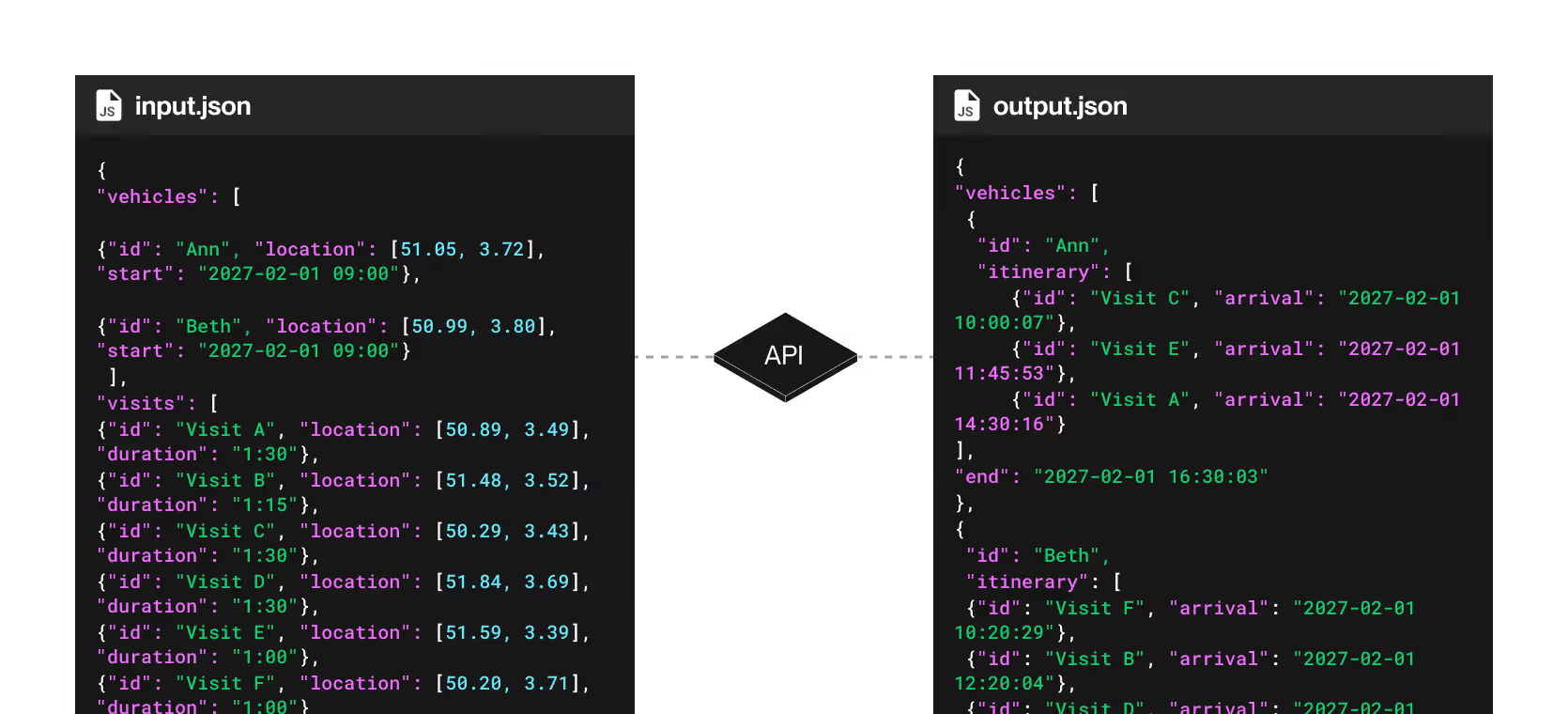
Your developers send JSON and render the plan that comes back.
Proof before commitment
Run a free benchmark on a real customer dataset inside a live deal.
MTTR / PM compliance / Technician utilization
JSON in, JSON out
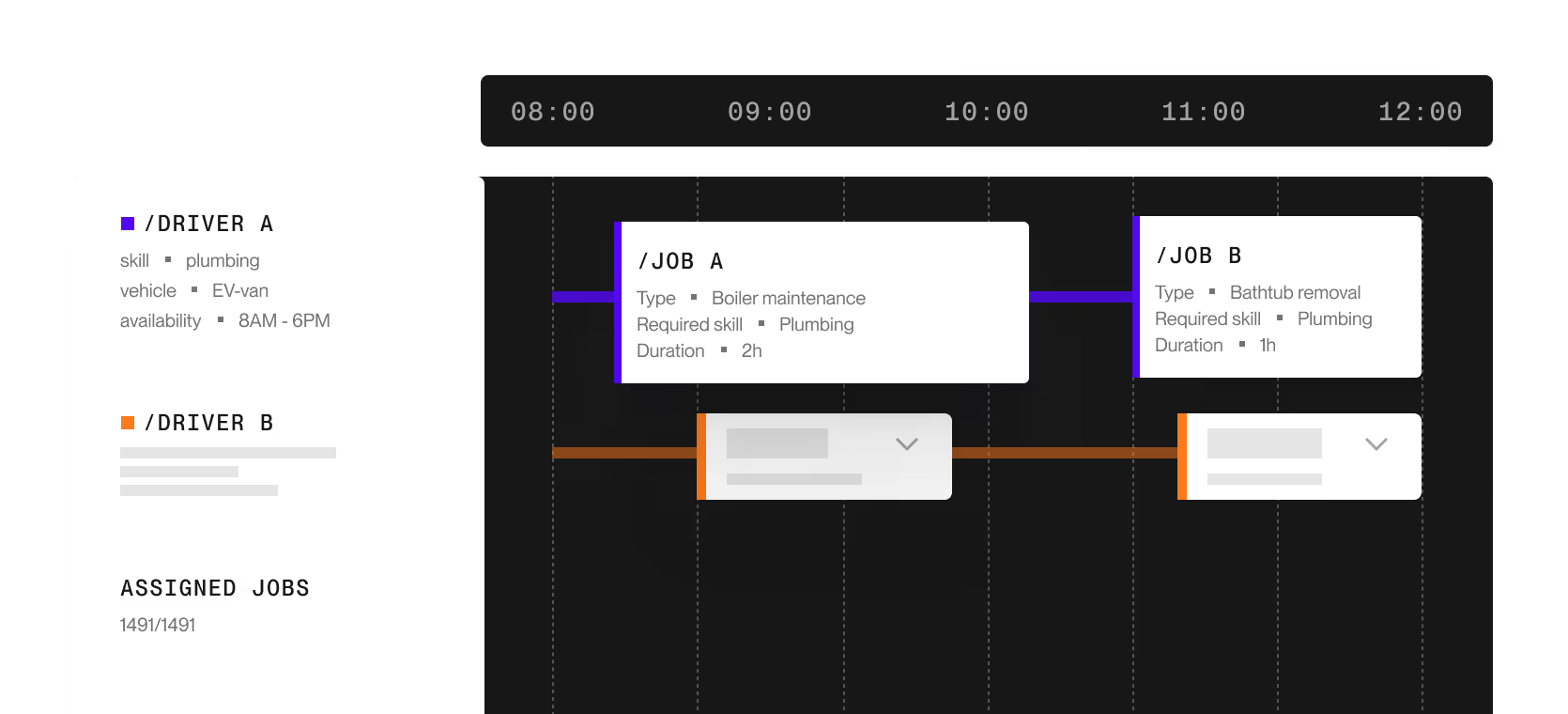
From your work orders to an optimized schedule inside your product.
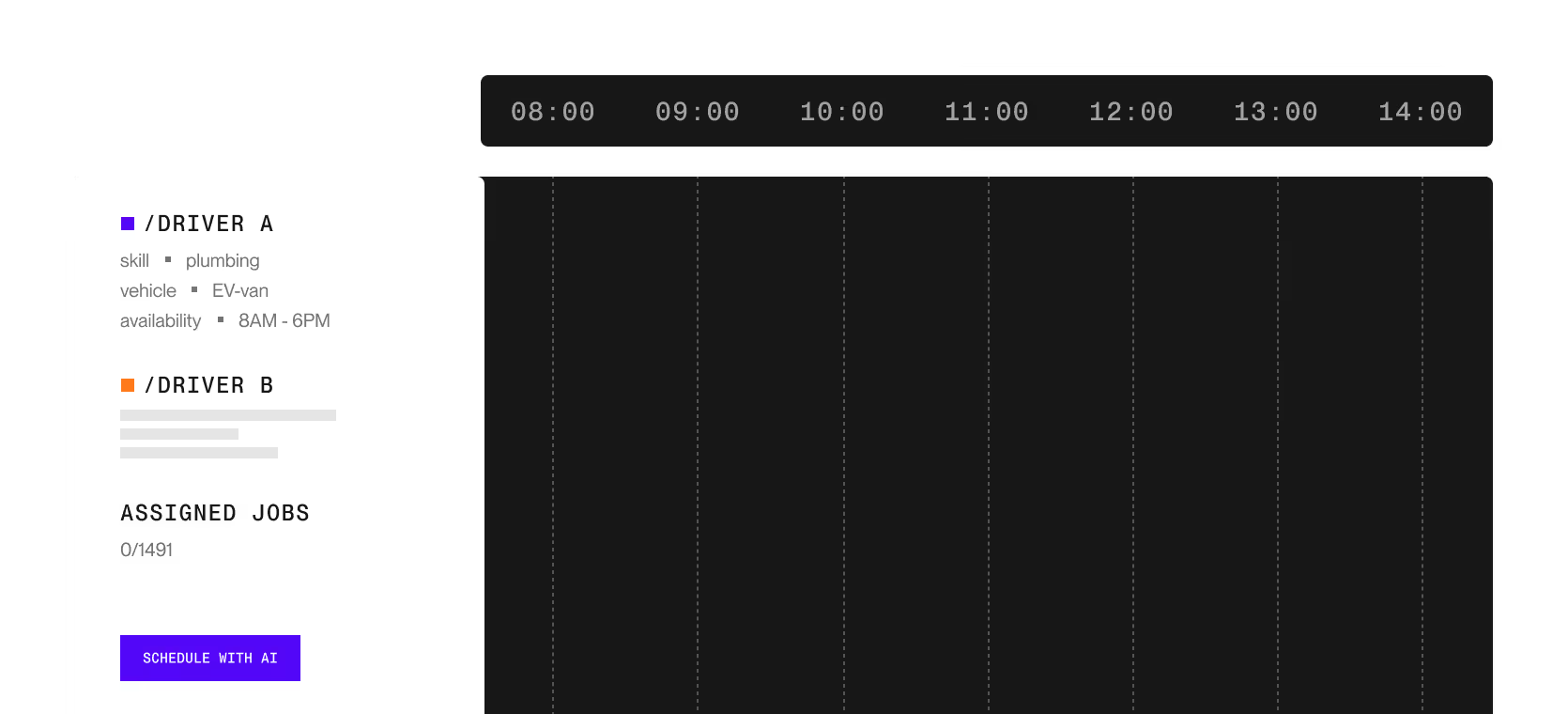

CBRE cut fleet mileage by 43%
Facility maintenance scheduling at enterprise scale.
less fleet mileage
saved per technician per day
less travel time
more time on tools
Dispatch ran on scripts that took days, followed by CSV uploads and manual fixes.
Planners overrode recommendations, and every rejected assignment started another round of calls.
Work orders assigned and sequenced by skills, location, opening hours, priority, and SLA.
Including urgent jobs with four-hour SLAs, balanced against travel, SLA performance, customer satisfaction, and the mix of internal technicians and outside vendors.
In their words

"We needed a solution that would integrate seamlessly into our technology stack. Timefold’s engineering-first mindset immediately stood out. Their capabilities are advanced and comprehensive, their APIs are exceptionally clean, and their economic model is both uncomplicated and well aligned with organizations that rely on a platform provider."

Questions from product and engineering leads
No. The constraints ship with the API and are set through configuration. Nobody on your side writes optimization code or tunes an algorithm.
Days to a first solve, weeks to a production schedule.
Underneath it. Agents decide that work needs doing. Timefold decides who goes where, and flags any plan that breaks a hard rule.
You do. We stay behind your product and contract with you.

Offer maintenance scheduling optimization in your product without building the engine yourself.