
Advanced route scheduling optimization for Joblogic

About Joblogic
Joblogic is a leading UK-based field service management platform supporting companies with engineer dispatching, back-office workflows, and mobile workforce operations.
As customer expectations evolved, the company set out to deliver next-generation scheduling and routing. And not years from now, but as an immediate step in their roadmap. To achieve this, they needed a proven optimization engine that could match the sophistication and speed the market now demands.
The challenge: Staying competitive in an evolving field service landscape
Facing real-world events with rigid planning tools
In field service, the “perfect plan” rarely survives the day. Breakdowns, emergencies, absences, and reactive jobs require real-time adjustment. Without adaptive routing, vendors risk leaving customers with service gaps, inefficient travel, and costly delays.
Buy vs. build paradox
Building an in-house optimization engine meant years of investment, uncertainty, and the risk of diverting engineers away from core product development. Integrating an external solution promised a faster path, but only if it matched Joblogic’s reliability, flexibility, and scale requirements.
Customer expectations and competition
Scheduling and routing logic had become a key requirement in RFPs. Joblogic’s customers increasingly expected sophisticated, automated scheduling. As competitors were beginning to position route optimization as a default feature, falling behind would impact win-rates and retention.
The ROI black box
To justify pricing and adoption, Joblogic needed clear, quantifiable benefits such as reduced travel time, fewer overtime hours, and more visits per engineer. Without transparent metrics, optimization remained a black box, making internal alignment and customer buy-in harder.
The solution: A powerful optimization engine for adaptive, efficient, and profitable planning
Real-time replanning
With Timefold, last-minute changes stopped causing a scramble. Emergency jobs, absences, and unexpected shifts now trigger instant, data-backed recommendations identifying who to send and why, keeping disruption to a minimum and service continuity high.
Fast-track integration
Joblogic’s team integrated Timefold's routing optimization via REST API, skipping years of internal development. This accelerated their go-to-market plan and allowed them to deliver intelligent scheduling far sooner than anticipated.
Configurable optimization
Customers can optimize routes for what matters most:
- shorter travel distances
- fewer overtime hours
- stronger SLAs
- balanced workloads
- improved employee satisfaction
This flexibility turns scheduling into a lever for both operational efficiency and workforce wellbeing.
Clear proof of value
With metrics like travel time, distance, completed visits, overtime cost, and CO₂ emissions, Joblogic’s users can demonstrate tangible ROI — to finance teams, operational leaders, or their own customers. Optimization becomes a measurable business advantage rather than a hidden process.
The outcome: Intelligent routing that strengthens Joblogic’s product and customers' operations
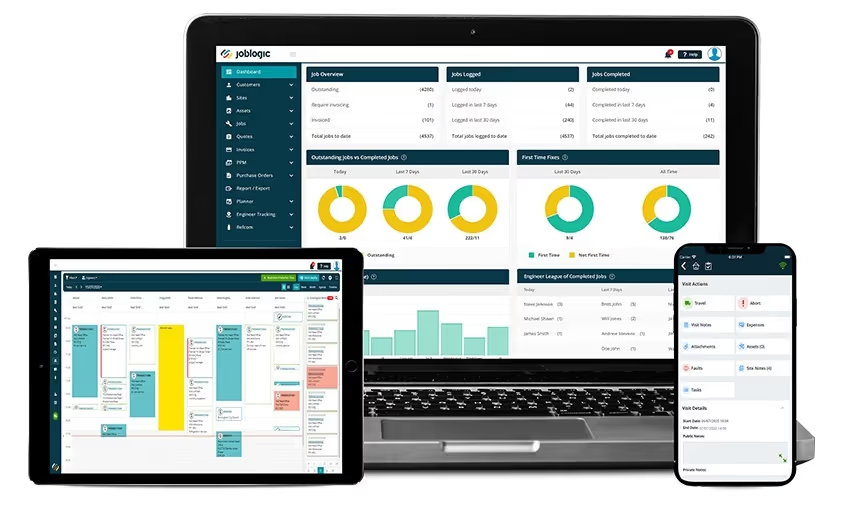
By embedding Timefold’s scheduling intelligence, Joblogic upgraded its platform with adaptive routing capable of handling disruptions, serving strategic goals, and proving clear efficiency gains.
Customers gain faster response times, reduced costs, and better-balanced workloads — while Joblogic strengthens its competitive positioning with a modern, AI-powered scheduling experience built for the realities of field service management.





When scheduling works, everything works.
Less waste. More control. Teams that trust the plan.