
How Timefold supports Factorial’s rapid growth with AI-powered & human-centric scheduling

About Factorial
Factorial is one of Europe’s fastest-growing HR and workforce management platforms, supporting businesses across France, Italy, Germany, Spain, and beyond. Their strategic ambition is clear: to build an AI-powered all-in-one platform that lets businesses manage time, talent, payroll, finance and workforce planning from a single place. To support this vision, Factorial needed a powerful scheduling engine that could match their ambition and the sophistication of their growing customer base.
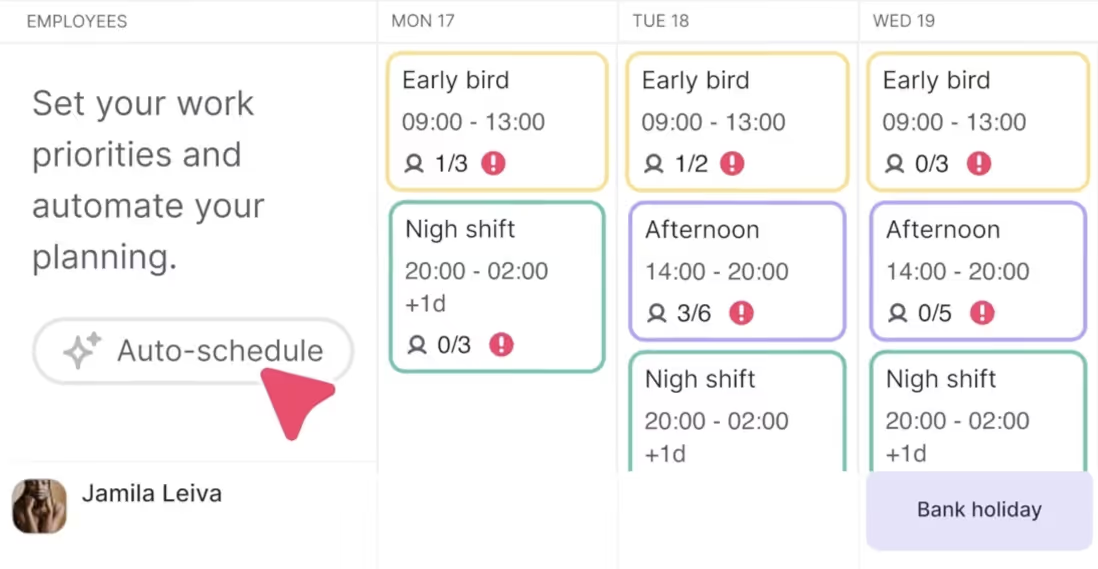
The challenge: Unscalable, manual scheduling
Manual scheduling
However, partnering with Timefold was more than a strategic decision. As their customer base expanded, so did the expectations placed on their scheduling features. Many of Factorial’s customers still relied on a fully manual, drag-and-drop workflow. Planners defined coverage needs for each location and assigned shifts individually, which created long, error sensitive planning cycles. This process became increasingly stressful as customer teams expanded and scheduling needs grew in volume and complexity. The lack of automation turned everyday planning into a bottleneck and placed unnecessary pressure on both planners and managers.
Labor regulations
Serving multiple countries added another layer of difficulty. France, Italy, Germany, and Spain all enforce different labor regulations covering required rest hours, contract dependent days off, and many other rules. Each schedule needed to respect these national requirements, but applying them consistently by hand was no longer sustainable. Factorial required a way to enforce regulations automatically and at scale.
Demand-based scheduling
Factorial also lacked the ability to create shifts from demand forecasts. Their existing scheduling flow worked only with predefined time slots, while many customers wanted to start from per hour coverage needs. They wanted to enter requirements such as three people from nine to twelve or two people from twelve to five, and automatically generate compliant shifts before assigning staff. This demand based model was essential for customers, yet impossible to achieve with their existing tools.
Scalability
Finally, Factorial needed predictable operational costs. Their customers range from small businesses to large enterprises, which made it difficult to estimate how usage would scale. Supporting rapid adoption required a cost structure that would remain stable even as customer usage increased significantly.
The Solution: A proven shift scheduling optimization engine
Automated scheduling out-of-the-box
Factorial integrated Timefold’s hosted Shift Scheduling API to provide automated shift generation across all customer types. This gave their users the ability to produce compliant, fair, and optimized schedules with a single click. The engine contains more than 70 built in constraints, which ensures that multi country compliance is the baseline rather than an extra responsibility for planners.
Hourly demand
Timefold’s Hourly Demand constraints also enabled Factorial to introduce demand based scheduling. Planners can now start from simple coverage requirements and let the system create compliant shifts before assigning staff. This capability was especially important for customers who operate in environments where staffing needs change per hour. It allowed Factorial to provide a more flexible and accurate scheduling experience.
Real-time re-optimization
The integration made it possible for Factorial to introduce real time re-optimization. When a worker calls in sick or a shift becomes unassigned unexpectedly, planners immediately receive recommended alternatives. This turns last minute disruptions into manageable decisions and gives planners a more stable and predictable workflow even during busy periods.
Predictable scaling
Timefold’s fixed monthly pricing ensured that Factorial could scale scheduling features to thousands of employees and locations without unpredictable cost spikes. This stability supported Factorial’s ambition to grow adoption across all markets while keeping full control over resource usage and budgeting.
The outcome: AI-driven, automated and optimized shift scheduling
With Timefold embedded in their platform, Factorial replaced long, manual scheduling efforts with automation that handles coverage needs, labor regulations, and last minute changes. Customers now receive accurate and flexible schedules at the click of a button. Planners gain time and peace of mind, and Factorial can confidently scale their AI-driven workforce management software across industries and countries.





When scheduling works, everything works.
Less waste. More control. Teams that trust the plan.